


Critical Swim Speed Test (CSS)
The Critical Swim Speed is defined as the theoretical swimming speed that can be maintained continuously without exhaustion. This test can be used by coaches and swimmers as a measure of aerobic capacity and also to determine swimming training intensities. A CSS test was described by Wakayoshi et al. (1992) using swims over 4 distances (50, 100, 200, 400m), and the CSS determine as the slope of the regression line relating distance and time. This was later simplified to a two-swim test (50m and 400m) by Ginn (1993) and using a simple formula to determine CSS. Below is the test as described by Ginn.
purpose: to calculate critical swim speed as a measure of endurance fitness, and to help set training swim intensities.
equipment required: a swimming pool (25m or 50m), stopwatch and an assistant.
pre-test: Explain the test procedures to the subject. Perform screening of health risks and obtain informed consent. Prepare forms and record basic information such as age, height, body weight, gender, test conditions. See more details of pre-test procedures.
procedure: After a standardised warm-up, swimmers are required to swim twice, over 400m and 50m, each at maximal pace, and with adequate time between swims for full recovery. The swimmer starts each swim in the water with a push start from the wall (no diving). An assistant is required to record the times for each swim. Use the time in seconds for each swim and the formula below to calculate CSS.
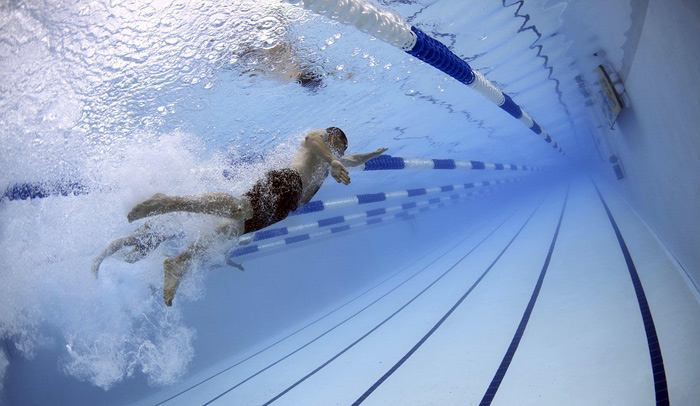 swimming efficiency
results: CSS in meters per second can be calculated using the following formula, where D1 = 50, D2 = 400, T1 = time for 50m swim in seconds and T2 = time for 400m swim in seconds:
CSS (m/sec) = (D2 - D1) ÷ (T2 - T1)
Ginn found that the CSS for a swimmer was about 80 to 85% of maximum 100m swim speed and 90 to 95% of their 400m swim speed.
usage: here is an example of using the CSS to determine the training times for the swimmer (from Ginne 1993). Using the swimmer's CSS (1.3 m/s in this case), for a session of 4 × 400m, the target time for each 400 meters is 400 ÷ 1.3 = 307.7 seconds or 5 minutes and 7.7 seconds.
target population: this is a test for swimmers. The test is appropriate for experienced swimmers (male and female), who can perform two maximal effort swims.
advantages: a simple test and calculation
validity: CSS has been shown to be well correlated with the swimming velocity corresponding to the onset of blood lactate accumulation (OBLA) and the maximal lactate steady state (Wakayoshi et al., 1992a & 1993).
references:
- Wakayoshi, K, Ikuta, K., Yoshida, T., Udo, M., Moritani, T., Mutoh, Y. & Miyashita, M. (1992a). Determination and validity of critical velocity as an index of swimming performance in the competitive swimmer. Eur. J. Appl. Physiol., 64, 153-157.
- Wakayoshi, K, Yoshida, T., Udo, M., Kasai, T., Moritani, T., Mutoh, Y. & Miyashita, M. (1992b). A simple method for determining critical speed as swimming fatigue threshold competitive swimming. International Journal of Sports Medicine, 13, 367-371.
- Ginn, E. (1993), "The application of the critical power test to swimming and swim training programs", National Sports Research Centre
- Ginn, E. (1993), "Critical speed and training intensities for swimming", Australian Sports Commission.
Similar Tests
- Swimming Beep Test — conducted in a 25m pool, starting at a speed of 1 m/sec and increasing by 0.05 m/sec every two minutes
- Swimming 7 x 200m Step Test — comprehensive measurements from multiple swims used to monitor changes in swimming specific aerobic conditioning.
- SWOLF — a measure of swimming efficiency
Related Pages
- About swimming endurance tests
- List of Fitness Tests for Swimmers
- Swimming Fitness Testing Protocols
 Any comments, suggestions, or corrections? Please let us know.
 Current Events