20m PACER Test Calculator
Quick Answer
This calculator instantly determines your VO₂max and FitnessGram Healthy Fitness Zone from your 20m PACER test laps. Results help athletes, students, and coaches assess cardiovascular fitness and track improvement over time.
- Calculates VO₂max using validated Mahar et al. (2006) formula (±6.5 ml/kg/min accuracy)
- Provides age and gender-specific FitnessGram Healthy Fitness Zone assessment
- Shows level breakdown, total distance, and sport-specific comparisons
What is the PACER Test?
The Progressive Aerobic Cardiovascular Endurance Run (PACER) test is a variation of the Beep Test, and is part of the FitnessGram and Brockport test batteries. It is a maximal aerobic fitness test, where the participants run 20m shuttles at increasing speeds. The speeds and levels of the 20 meter PACER test is based on the original details of the shuttle run test developed by Leger et al. (1988). There is also a 15m PACER test for use where space is limited.
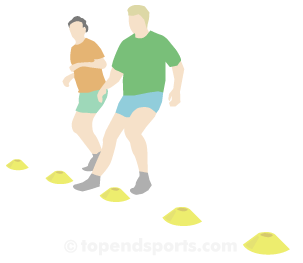
During the test, participants run 20-meter shuttles back and forth between two lines, keeping pace with audio beeps. The initial speed is 8.0-8.5 km/hr, increasing by 0.5 km/hr each level (approximately every minute). The test continues until the participant fails to reach the line before the beep on two consecutive occasions.
Equipment Required
Equipment required: Flat non-slip surface, marking cones, up to 20m measuring tape, PACER test cd, cd player, recording sheets.
Pre-Test Procedures
Pre-test: Explain the test procedures to the subject. Perform screening of health risks and obtain informed consent. Prepare forms and record basic information such as age, height, body weight, gender and test conditions (indoors/outdoors, weather, running surface). Measure and mark out the course. Perform a standard warm-up. See more details of pre-test procedures.
Test Procedure
Procedure: There are two variations of this test, with the lines placed either 15 or 20 meters apart. The 15m test distance is used for 2nd and 3rd grade students or when there are space limitations. The test involves continuous running between the two lines in time to recorded beeps. The initial speed is 8.5km/hr, which increases by 0.5km/hr each level (approximately every minute). The time between recorded beeps decrease each minute (level) requiring an increase in pace. The participants continue until they are unable to keep pace with the beeps. (see details of PACER test levels and speeds).
Scoring
Scoring: The score is the total number of shuttles reached before the athlete was unable to keep up with the recording for two consecutive ends. The test scores can be entered into the FitnessGram software for analysis. If the 15m version is used, there is a conversion chart to convert scores on the 15m PACER to a 20m score to enter in the FitnessGram software.
Target Population
Target population: The test is suitable for sports teams and school groups of all ages, but not for people in which a maximal exercise test could be considered dangerous.
Reliability
Reliability: Reliability would depend on how strictly the test is run, and the practice allowed for the participants. Several practice trials would be ideal.
Advantages
Advantages: Large groups of children can perform this test all at once for minimal costs. Also, the test continues to maximum effort unlike many other tests of endurance capacity. If there is not enough room to conduct the 20m test, there is a 15m version. If required you can convert the score for the 15m to 20m versions using this conversion chart.
Disadvantages
Disadvantages: Practice and motivation levels can influence the score attained, and the scoring can be subjective. As the test is usually conducted outside, the environmental conditions can also affect the results.
Comments
- This test is a maximal test which requires a reasonable level of fitness - care must be taken with students who are sick, of poor fitness or elderly.
- The FitnessGram cd also provides the cadences for the curl-up and push-up portions of the test battery
How to Use This Calculator
Follow these simple steps to calculate your PACER test results and fitness assessment:
- Enter Your Total Laps - Input the total number of 20m shuttles you completed during the PACER test. This is your raw score before the test ended due to two consecutive missed beeps.
- Enter Your Age - Provide your age in years. The calculator uses this for age-specific VO₂max estimation and FitnessGram standards comparison.
- Select Your Gender - Choose male or female for accurate Healthy Fitness Zone assessment, as standards differ by gender.
- Calculate Results - Click the Calculate button to instantly see your VO₂max, fitness zone classification, level breakdown, and training recommendations.
Pro Tip: For the most accurate VO₂max estimation, ensure you gave maximal effort during the PACER test. Submaximal performance will underestimate your true aerobic capacity. The calculator assumes you completed the test to exhaustion.
Understanding Your Results
VO₂max (Maximal Oxygen Uptake)
VO₂max represents the maximum rate at which your body can consume oxygen during intense exercise. It's expressed in milliliters of oxygen per kilogram of body weight per minute (ml/kg/min). Higher values indicate greater cardiovascular fitness and aerobic endurance capacity.
This calculator uses the validated regression equation from Mahar et al. (2006):
VO₂max = 45.619 + (PACER laps × 0.353) - (Age × 1.121)
Research indicates this formula predicts VO₂max with a standard error of approximately ±6.5 ml/kg/min when compared to direct treadmill testing.
FitnessGram Healthy Fitness Zone (HFZ)
The FitnessGram program uses criterion-referenced standards rather than percentile rankings. The Healthy Fitness Zone indicates a level of fitness associated with health benefits. Results are classified into three categories:
| Zone | Meaning | Recommendation |
|---|---|---|
| Healthy Fitness Zone (HFZ) | Adequate fitness for health benefits | Maintain current activity level; continue age-appropriate training |
| Needs Improvement (NI) | Below optimal fitness level | Gradually increase aerobic activity; aim for 30-60 min daily |
| Needs Improvement - Health Risk (NI-HR) | Fitness level associated with health risk | Consult healthcare provider; begin supervised activity program |
PACER Test Levels and Scoring
The 20m PACER test consists of 21 levels with a maximum of 247 laps. Each level lasts approximately one minute, with speed increasing 0.5 km/hr per level. The number of shuttles per level varies from 7-9 depending on the level.
| Level | Speed (km/hr) | Shuttles | Cumulative Laps | Distance (m) |
|---|---|---|---|---|
| 1 | 8.0 | 7 | 7 | 140 |
| 2 | 8.5 | 8 | 15 | 300 |
| 3 | 9.0 | 8 | 23 | 460 |
| 4 | 9.5 | 9 | 32 | 640 |
| 5 | 10.0 | 9 | 41 | 820 |
| 6 | 10.5 | 10 | 51 | 1020 |
| 7 | 11.0 | 10 | 61 | 1220 |
| 8 | 11.5 | 11 | 72 | 1440 |
| 9 | 12.0 | 11 | 83 | 1660 |
| 10 | 12.5 | 11 | 94 | 1880 |
For complete level details including levels 11-21, see the PACER Test Levels and Speeds page.
FitnessGram Healthy Fitness Zone Standards
The following table shows the minimum PACER laps required to achieve the Healthy Fitness Zone by age and gender:
| Age | Boys - HFZ Minimum | Boys - HFZ Maximum | Girls - HFZ Minimum | Girls - HFZ Maximum |
|---|---|---|---|---|
| 10 | 23 | 61 | 7 | 41 |
| 11 | 23 | 72 | 15 | 41 |
| 12 | 32 | 72 | 15 | 41 |
| 13 | 41 | 83 | 23 | 51 |
| 14 | 41 | 83 | 23 | 51 |
| 15 | 51 | 94 | 32 | 51 |
| 16 | 61 | 94 | 32 | 61 |
| 17+ | 61 | 94 | 41 | 61 |
Sport-Specific PACER Performance Standards
Different sports require varying levels of aerobic fitness. The following guidelines show typical PACER performance expectations for athletes:
Endurance Sports (Soccer, Basketball, Hockey)
Elite youth soccer players typically achieve 80-100+ laps on the PACER test. Division I college soccer programs often expect 80+ laps for males and 60+ for females. Basketball and hockey players generally fall in similar ranges due to the intermittent high-intensity nature of these sports.
Team Sports (Volleyball, Baseball, Softball)
These sports require moderate aerobic fitness with greater emphasis on power and skill. Athletes typically achieve 50-75 laps, with position-specific variation.
Power Sports (Football, Wrestling, Weightlifting)
While aerobic capacity remains important for recovery, these athletes may score 40-70 laps depending on position and training phase.
| Sport | Males (typical range) | Females (typical range) | Elite Level |
|---|---|---|---|
| Soccer | 70-100+ | 50-80+ | 100+ laps |
| Basketball | 65-90 | 45-70 | 90+ laps |
| Track (distance) | 85-120+ | 65-100+ | 120+ laps |
| Swimming | 60-85 | 45-65 | 85+ laps |
| Football (skill) | 55-80 | N/A | 80+ laps |
| Wrestling | 50-75 | 40-60 | 75+ laps |
How to Improve Your PACER Score
Improving your PACER test performance requires consistent aerobic training over 6-12 weeks. Research shows that structured interval training and progressive overload are most effective for improving shuttle run performance.
Training Recommendations by Fitness Level
Needs Improvement Zone (NI/NI-HR)
- Begin with 20-30 minutes of continuous moderate activity 3-4 days per week
- Focus on activities like jogging, cycling, or swimming at conversational pace
- Gradually increase duration by 5 minutes every 1-2 weeks
- Add short intervals (30 seconds faster pace) once base fitness improves
Lower Healthy Fitness Zone
- Maintain 30-45 minutes of aerobic activity 4-5 days per week
- Include 1-2 interval training sessions weekly
- Practice shuttle runs at PACER pace to improve turning technique
- Add sport-specific conditioning relevant to your activity
Upper Healthy Fitness Zone / Athletic Level
- Train 45-60 minutes 5-6 days per week with periodized programming
- Include high-intensity interval training (HIIT) 2-3 times weekly
- Practice specific PACER pacing strategies and turning efficiency
- Consider tempo runs and threshold training for advanced improvement
Training Tip: For PACER-specific improvement, practice running 20m shuttles at your target pace. Use the free beep test audio download to train at exact test speeds.
⚠️ Safety Note: This is a maximal exercise test. Ensure participants are healthy and appropriately screened. Stop immediately if any participant shows signs of distress, dizziness, or chest pain.
Frequently Asked Questions
What is a good PACER test score for my age?
Good scores vary significantly by age and gender. For boys aged 14-18, achieving 60-85 laps is considered good to excellent. For girls in the same age range, 35-55 laps is good to excellent. Use the calculator above to compare your score to FitnessGram standards for your specific age and gender.
How accurate is the VO₂max estimation from PACER?
Research by Mahar et al. (2006) shows that PACER-based VO₂max estimates have a standard error of approximately ±6.5 ml/kg/min compared to direct laboratory measurement. Accuracy is highest when participants give maximal effort during the test.
Can adults use this calculator?
Yes, the VO₂max calculation works for adults. However, the FitnessGram Healthy Fitness Zone standards are designed for ages 5-17. Adults can compare their VO₂max to general population norms: excellent (>49 for men, >42 for women), good (43-48 for men, 37-41 for women), average (34-42 for men, 28-36 for women).
What's the difference between the PACER and beep test?
The PACER is essentially a standardized version of the beep test used in the FitnessGram program. Both tests use 20m shuttles with progressively increasing speeds. The main difference is that PACER has specific standardized audio recordings and scoring criteria developed by The Cooper Institute.
How often should I take the PACER test?
For tracking fitness progress, testing every 6-8 weeks allows enough time for meaningful improvements while not over-testing. Schools typically administer the test 1-2 times per year. Athletes in intensive training may test monthly during off-season preparation.
Should I use the 15m or 20m PACER version?
The 20m version is the standard and provides the most comparable results. Use the 15m version only when space limitations prevent a 20m course. If using the 15m test, use our conversion calculator to convert scores to 20m equivalents.
Why did my score decrease from last time?
PACER scores can vary due to motivation, fatigue, illness, environmental conditions, time of day, and recent training load. Ensure consistent testing conditions and adequate rest before testing. A single test may not accurately reflect your true fitness level.
References
- Mahar, M.T., Guerieri, A.M., Hanna, M.S., & Kemble, C.D. (2011). "Estimation of aerobic fitness from 20-m multistage shuttle run test performance." American Journal of Preventive Medicine, 41(4), S117-S123.
- Leger, L.A., Mercier, D., Gadoury, C., & Lambert, J. (1988). "The multistage 20 metre shuttle run test for aerobic fitness." Journal of Sports Sciences, 6(2), 93-101.
- Mahar, M.T., Welk, G.J., Rowe, D.A., Crotts, D.J., & McIver, K.L. (2006). "Development and validation of a regression model to estimate VO₂peak from PACER 20-m shuttle run performance." Journal of Physical Activity and Health, 3(S2), S34-S46.
- McClain, J.J., Welk, G.J., Ihmels, M., & Schaben, J. (2006). "Comparison of two versions of the PACER aerobic fitness test." Journal of Physical Activity and Health, 3(S2), S47-S57.
- The Cooper Institute. (2017). FITNESSGRAM/ACTIVITYGRAM Test Administration Manual (5th ed.). Human Kinetics.
- Ruiz, J.R., et al. (2011). "Field-based fitness assessment in young people: the ALPHA health-related fitness test battery for children and adolescents." British Journal of Sports Medicine, 45(6), 518-524.
- Tomkinson, G.R., et al. (2019). "European normative values for physical fitness in children and adolescents aged 9-17 years." British Journal of Sports Medicine, 52(22), 1445-1456.
Related Products
- Buy the 20m or 15m PACER test cd — this recording provides pacing for the shuttle run portion of the test as well as audio tracks with the cadences for the curl-up and push-up tests.
- Buy the Fitnessgram/Activitygram Test Manual which includes a DVD with video clips and the PACER test cd.
Similar Tests
- 15m PACER test
- 15m Bleep Test — a shorter version of the beep test
Related Pages
- The conversion chart to assist converting scores on the 15m PACER to a 20m score.
- PACER Test 15m & 20m Levels and Speeds.
- This test is part of the FitnessGram and Brockport Test battery.
- Guide to Variations of the beep / bleep test
- More Modified Beep Tests
- The complete guide to the beep test for comprehensive information about the beep test
- Maximizing Your Score — to get the most out of the beep test.
 Any comments, suggestions, or corrections? Please let us know.